



TOOL GUIDE
// HOW TO CHOOSE A BURR PROFILE
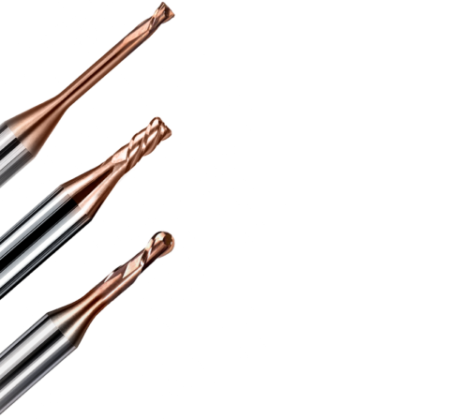
The profile refers to the shape of the cutting end of the burr and is generally available in three main types: cylindrical, toric, and ball nose.
// Cylindrical Profile:
These tools feature a flat end and sharp cutting edges arranged to form a 90° angle.
// Toric Profile:
This rounded-edge profile is used for roughing operations. It features a sharp corner softened by a radius. This rounding helps distribute cutting forces more evenly across the corner, helping prevent wear and chipping, and therefore extending tool life.
// Ball Nose Profile:
This profile refers to tools whose cutting edges do not have a flat end, but a fully rounded end, creating a smooth hemispherical shape at the tip of the burr.
// COMMON MISTAKES IN MILLING
// Incorrect Feed Rate: Too Low or Too High
The ideal feed rate for machining can vary significantly depending on the type of tool and the material being processed.
If the feed rate is too low, there is a risk of recutting the chips, which can accelerate tool wear. If, on the other hand, the feed rate is too high, the tool may fracture.
// ANATOMY OF A BURR
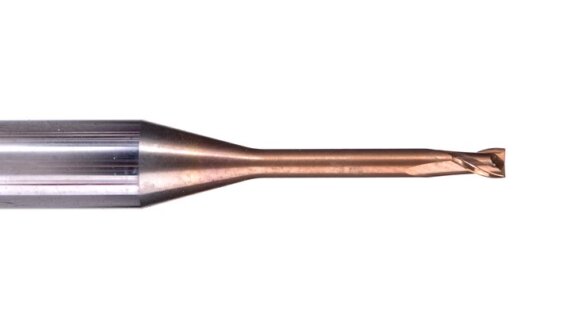
Burrs can feature many different dimensions, which are specified in the tool description.
It is important to understand how each dimension can affect tool selection and how even small variations can make a significant difference when the tool is rotating.
// HOW TO CHOOSE THE NUMBER OF FLUTES (Z) OF A BURR
Traditionally, burrs can have one or more flutes. The most common rule is to use two flutes for milling aluminum and softer materials such as PMMA and zirconia, and four flutes for milling harder alloys such as cobalt-chromium and titanium.
Since aluminum and non-ferrous alloys are generally softer than steel, tool strength is not as critical. The tool can run at higher feed rates and provide greater material removal thanks to the wider chip gullets of a two-flute geometry, where the larger space between the flutes helps facilitate chip evacuation.
Ferrous materials, on the other hand, are generally much harder and require the strength of a larger core. Feed rates are slower, producing smaller chips that can be evacuated through the narrower spaces between the flutes of a tool with a larger core.
This also makes it possible to include more flutes on the tool, which in turn increases productivity.
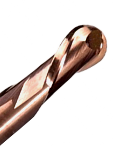
The key to modern milling techniques is finding the right balance. Flutes, also identified by the letter “Z”, are the most easily recognizable part of a solid burr and represent the cutting section that allows the tool to remove material.
The key to modern milling techniques is finding the right balance.
Flutes, also identified by the letter “Z”, are the most easily recognizable part of a solid burr. They are the cutting section of the tool that enables material removal.
// SURFACE TREATMENT OF BURRS USED FOR MATERIAL MACHINING
SURFACE TREATMENT OF BURRS USED FOR MACHINING COBALT-CHROMIUM AND TITANIUM
The coating used by STARS3® has been specifically developed for high-speed, dry machining — or machining with minimal lubrication — of hard materials.
This coating preserves the integrity of the cutting edge at temperatures of up to 1200 °C.
The coating used by STARS3® can be successfully applied in high-speed machining of hard materials, such as steel and alloys with a high nickel and titanium content.
It is particularly suitable for carbide burrs used in roughing and finishing operations that generate high temperatures at the chip/cutting-edge interface.
Cutting speeds generally range from 100 to 300 m/min, depending on working conditions and the type of material being machined.
FOR MORE INFORMATION